
Free Chemistry NEET Notes for Some Basic Concepts Of Chemistry
Free Chemistry Notes available for Some Basic Concepts Of Chemistry (NEET)
Power up your NEET Exam prep with Chapter-Wise Chemistry Notes for Some Basic Concepts Of Chemistry at Onlineneetcoaching.in. Crafted by Brilliant Tutorial experts with 25 years of NEET insights.
- Some Basic Concepts Of Chemistry -
Important Chemistry Notes for IITJEE/NEET Preparation- Some Basic Concepts Of Chemistry
Class 11 Chemistry is a broad subject that requires a thorough understanding of the concepts and topics covered. As a result, we have provided Chemistry Notes PDF for IIT JEE/NEET to students and NEET aspirants. Some Basic Concepts Of Chemistry Class 11 Notes PDF for NEET can be found below. With the help of detailed syllabus, Class 11 students learn what they need to study, how many points are assigned to each unit, and how much time is allotted for each unit. As a result, they can easily plan their study schedule.
Check out the Some Basic Concepts Of Chemistry Class 11 notes PDF for your IIT JEE/NEET Preparation based on the IIT JEE/NEET Chemistry Syllabus. The Some Basic Concepts Of Chemistry notes PDF is designed in such a way that it is very useful for IIT JEE/NEET aspirants.
SOME BASIC CONCEPTS OF CHEMISTRY
PHYSICAL QUANTITIES AND SI UNITS
FUNDAMENTAL UNITS
Physical Quantity
|
Abbreviation
|
Name of unit
|
Symbol
|
time
|
t
|
second
|
s
|
mass
|
m
|
kilogram
|
kg
|
length
|
l
|
metre
|
m
|
temperature
|
T
|
kelvin
|
K
|
electric current
|
I
|
ampere
|
A
|
light intensity
|
Iv
|
candela
|
Cd
|
amount of substance
|
n
|
mole
|
mol
|
DERIVED UNITS
Physical Quantity
|
Definition
|
SI Unit
|
volume
|
length cube
|
m3
|
area
|
length square
|
m2
|
speed
|
distance travelled
|
ms–1
per unit time
|
acceleration
|
speed changed
|
ms–2
per unit time
|
density
|
mass per unit volume
|
kg m–3
|
pressure
|
force per unit area
|
kgm–1s–2 or Nm–2 (pressure = Pa)
|
force
|
mass times acceleration of object
|
kgms–2 (Newton N)
|
energy
|
force times distance travelled
|
kgm2s–2(Joule J)
|
frequency
|
cycles per second
|
s–1 (hertz = Hz)
|
power
|
energy per second
|
kgm2s–3 or Js–1
(Watt = W)
|
electric charge
|
ampere times second
|
As (coloumb = C)
|
electric potential
|
energy per unit
|
JA–1s–1 or kgm2s–3
|
difference
|
charge
|
A–1 (volt = V)
|
SOME NON-SI UNITS IN COMMON USE
Quantity
|
Unit
|
Symbol
|
SI definition
|
SI Name
|
Length
|
angstrom
|
Å
|
10–10 m
|
0.1 nanometers (nm)
|
Volume
|
litre
|
L
|
10–3 m3
|
1 decimeter (dm3)
|
Energy
|
calorie
|
cal
|
kg m2s–2
|
4.184 Joule (J)
|
STANDARD PREFIXES FOR EXPRESSING THE DECIMAL FRACTIONS OR MULTIPLES OF FUNDAMENTAL UNITS
Fraction
|
Prefix
|
Symbol
|
Multiple
|
Prefix
|
Symbol
|
10–1
|
deci
|
d
|
101
|
Deka
|
da
|
10–2
|
centi
|
c
|
102
|
Hecta
|
h
|
10–3
|
milli
|
m
|
103
|
kilo
|
k
|
10–6
|
micro
|
m
|
106
|
Mega
|
M
|
10–9
|
nano
|
n
|
109
|
Giga
|
G
|
10–12
|
pico
|
p
|
1012
|
Tera
|
T
|
10–15
|
femto
|
f
|
1015
|
Peta
|
P
|
10–18
|
atto
|
a
|
1018
|
Exa
|
E
|
PRECISION AND ACCURACY

STOICHIOMETRY
 2NH3(g)
- One mole of N2(g) reacts with three moles of H2(g) to give two moles of NH3(g).
- 28g of N2(g) reacts with 6g at H2(g) to give 34g of NH3(g).
- 22.4L of N2(g) reacts with 67.2L of H2(g) to give 44.8L of NH3(g)
SIGNIFICANT FIGURES
- Significance of zero : If zero is used to locate the decimal point it is not considered as significant figure. Thus in 0.0072 there are only two significant figures whereas in 70.40, there are four significant figures since zero is after 4. Again in 0.0070 there are two significant figures, since zero after 7 is significant for it has a meaning when written in exponentials. If we compare 7.0 × 10⁻³ and 7 × 10⁻³, the first term has uncertainty of one in seventy and second has uncertainty of one in seven. The exponential term does not add to number of significant figures.
- Addition and subtraction of quantities : In this case the uncertainty in the result is equal to the sum of the uncertainties of the individual quantities.
- Multiplication and division : In this case the uncertainty in the result is equal to the sum of the percentage of individual uncertainties.
- Rounding off : The following rules are observed.
- If the digit after the last digit to be retained is less than 5, the last digit is retained as such. e.g. 1.752 = 1.75 (2 is less than 5).
- If the digit after the last digit to be retained is more than 5, the digit to be retained is increased by 1. e.g. 1.756 = 1.76 (6 is more than 5).
- If the digit after the last digit to be retained is equal to 5, the last digit is retained as such if it is even and increased by 1 if odd.
- Calculations involving addition and subtraction : In case of addition and subtraction the final result should be reported to the same number of decimal places as the number with the minimum number of decimal places .
- Calculations involving multiplication and division : In this case the final result should be reported having same number of significant digits as that of the number having least significant digits.
MATTER
CLASSIFICATION OF MATTER
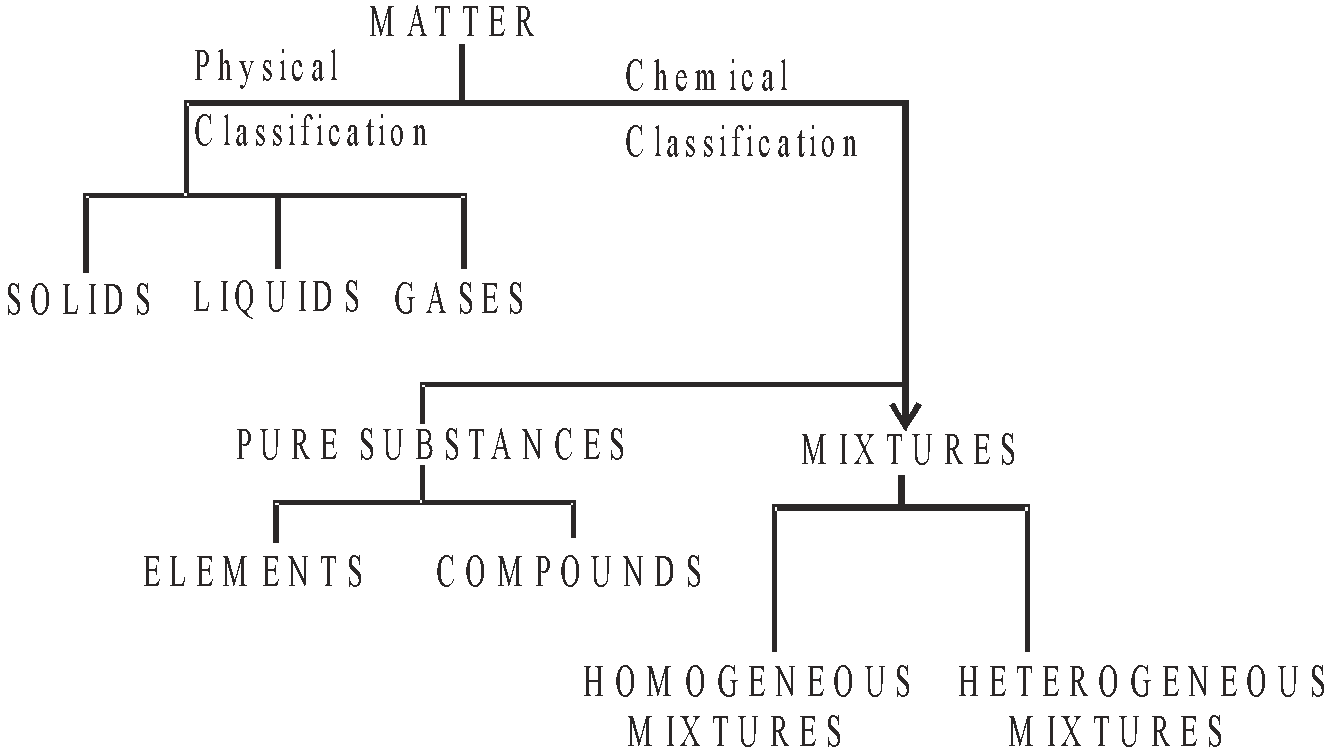
ELEMENT
COMPOUND
MIXTURES
SEPARATION OF MIXTURES
- Filtration can separate those mixtures whose one component is soluble in a particular solvent and other is not.
- Distillation can be used to separate constituents of mixtures having different boiling points.
- Extraction dissolves one out of several components of mixture.
- Crystallisation is a process of separating solids having different solubilities in a particular solvent.
- Sublimation separates volatile solids which sublime on heating from non-volatile solids.
- Chromatography is the technique of separating constituents of a mixture which utilises the property of difference of adsorption on a particular adsorbent.
- Gravity separation separates constituents having different densities.
- Magnetic separation can separate magnetic components from non magnetic ones.
PHYSICAL AND CHEMICAL CHANGES
- Chemical Combination is reaction between two or more elements or compounds to form a single substance.
 2HI
2HI- Displacement means replacement of one element of compound by another.
- Decomposition involves splitting of a compound to form two or more substances.

- Combustion is a complete and fast oxidation of a substance.

- Neutralisation is the reaction between acid and base to form a salt.

- Polymerisation is the combination of molecules of same or different substances to form a single molecule called polymer
- Photochemical changes occur in presence of visible or ultraviolet light.
- Double decomposition or metathesis is the exchange of oppositely charged ion on mixing two salt solutions.
- Hydrolysis involves reaction of salts with water to form acidic or basic solutions.

LAWS OF CHEMICAL COMBINATIONS
- Law of conservation of mass : This law was given by French chemist A. Lavoisier (1774) which states that "during any physical or chemical change, the total mass of products is equal to the total mass of reactants". It is also called law of indistinctibility. It does not hold good for nuclear reaction.
- Law of definite proportions : This law was given by Proust (1799) and states that "a chemical compound always contains some elements combined together in same proportion by mass". For example different samples of pure CO2 always have carbon and oxygen in 3 : 8 ratio by mass.
- Law of multiple proportions : This law was given by John Dalton (1803) and states that "when two elements combine to form two or more compounds, the different mass of one of the elements and the fixed mass of the one with which it combines always form a whole number ratio". This law explains the concept of formation of more than one compound by two elements.
- Law of reciprocal proportions : This was given by Richter (1792) and states that "when two elements combine separately with a fixed mass of third, the ratio of masses in which they do so is same or whole number multiple of the ratio in which they combine with each other." This law is also called law of equivalent proportions and is helpful in determining equivalent weights.
- Gay Lussac's law of combining volumes : This law states that when gases react with each other, their volumes bear a simple whole no. ratio to one another and to volume of products (if gases) and similar conditions of pressure and temperature.
- Dalton's atomic theory :
- Proposed by John Dalton in 1808. Main points are :
- Matter is made up, by indivisible particles called atoms
- Atoms of same elements are identical in physical and chemical properties.
- Atoms of different substances are different in every respect
- Atoms always combine in whole numbers to form compounds
- Atoms of resultant compounds possess similar properties
- Does not explain structure of atom.
- Fails to explain binding forces between atoms in compounds.
- Does not explain Gay Lussac's law.
- Does not differentiate between atom and molecule.
- Avogadro's law :
- Deducing atomicity of elementary gases
- Deriving relationship between molecular mass and vapour density
- Deriving formula of substances
- Determining molecular wt. of a gas
- Deducing the gram molecular volume.
ATOM
MOLECULE
- Homoatomic molecules are molecules of same element and can be further divided as monoatomic, diatomic and polyatomic molecules depending upon number of atoms. eg: He, O2, P4 etc.
- Heteroatomic molecules are molecules of compound. They can be diatomic and polyatomic. eg: H2O, PCl5, H2SO4, NO etc.
ATOMIC MASS UNIT (A.M.U.)
 th the mass of C-12.
MOLE
ATOMIC MASS

AVERAGE ATOMIC MASS

DETERMINATION OF ATOMIC MASS
- Dulong and petit's rule : It is based on experimental facts. "At ordinary temperature, product of atomic mass and specific heat for solid elements is approximately 6.4 and this product is known as atomic heat of the element"
- Specific heat method : This method is for gases.
, where Cp = specific heat at constant pressure and Cv = specific heat at constant volume. the ratio g is a constant = 1.66 for monoatomic, 1.40 for diatomic, 1.33 for triatomic gas and atomic mass of gaseous element

- Chloride formation method : This method converts the element (whose mass is to be determined) into volatile chloride whose vapour density is found by Victor Mayer method.
- Vapour density method is suitable for elements having volatile chlorides.
- Mitscherlich's law of isomorphism : It states that isomorphous substances have similar chemical constitution. Isomorphous substances form crystals of same shape and valencies of elements forming isomorphous salts are also same. eg: ZnSO4. 7H2O, MgSO4.7H2O and FeSO4.7H2O are isomorphous.
GRAM ATOMIC MASS (GAM)

MOLECULAR MASS :

CALCULATION OF MOLECULAR MASS :
- Graham's law of diffusion : It states that rate of diffusion of two gases is inversely proportional to the square root of ratio of their molecular weights.

- Victor meyer method : This method can determine the molecular mass as
 × 22400
- Vapour density method : Vapour density is the ratio of volume of a gas to the mass of same volume of hydrogen under identical conditions.


- Colligative properties method : This method can be helpful in determining molecular mass as

 Tb is elevation in b.p., Kb is molal elevation constant w is wt. of solute W is wt. of solvent
GRAM MOLECULAR MASS OR MOLAR MASS :

EQUIVALENT MASS :
- Equivalent mass for elements =
- Equivalent mass for acids =
- Equivalent mass for bases =
- Equivalent mass for salts =
- Equivalent mass for oxidising agents =
- Equivalent mass for reducing agents =
- Equivalent weight of radicals =







FORMULA MASS :
ACIDITY :
BASICITY :
GRAM EQUIVALENT MASS (GEM) :
 .
.METHODS OF DETERMINING EQUIVALENT MASSES :
- Hydrogen displacement method : It is for metals which can displace H2 from acids.


- Metal displacement method : It utilises the fact that one GEM of a more electropositive metal displaces one GEM of a less electropositive metal from its salt
.
- Conversion method : When one compound of a metal is converted to another compound of similar metal then


- Electrolytic method :
It states that the quantity of substance that reacts at electrode when Faraday of electricity is passed is equal to its GEM.
- Oxide method :


- Double decomposition :




- Neutralisation method for acids and bases :

- Silver salt is method commonly used for organic acids.

- Platinichloride method for bases :

- Chloride method :


- Volatile chloride method :


CHEMICAL EQUATION :
- An equation which has not been equalised in terms of number of atoms of reactants and products is called a skeleton equation.
- An equation having equal number of atoms of various kinds on both sides is a balanced equation.
EMPIRICAL FORMULA :
MOLECULAR FORMULA :
SOLUTION :
MOLE FRACTION :
 , where n is the number of moles.
MASS PERCENTAGE :

VOLUME PERCENTAGE :

PARTS PER MILLION (PPM) :

NORMALITY :


MOLARITY :


 =
=  , where d = density

MOLALITY :


FORMALITY (F) :
